
18 February 2026
Dear Ones,
 January came and went––Whoosh! Now, we are fully in February. While community members in the southern hemisphere are enjoying holiday travel and the height of summer activities, these 28 days are most associated with winter, Mardi Gras, Black History Month, Super Bowl, and primroses that are early signs of spring in the northern hemisphere. Some may know that Ash Wednesday (the start of a period for reflection, repentance, and fasting during Lent that is important to Christians) coincides this year with Ramadan with its similar practices for Muslims. However, this letter is not about cultural events or seasons. Instead, it is a “love letter” of sorts. No, I don’t intend to babble on about the origins of Valentine’s Day. My own curiosity is not how the month of February is unmistakably recognized as a catalyst for love in what seems like more parts of the world. Instead, I will risk sounding ridiculous to a Sufi community by saying that what we think about love today is misunderstood, misdirected, and misrepresented. The commonplaceness of love, I want to reason, that everyone just accepts is not sincere.
To start with, my concern is not with modern relationships, the institution of marriage, or dating apps. Rather, I want to briefly look at the concept of love. There are many more qualified commentators on this topic. It’s just that I am at a loss with what I have seen lately.
Some sages have held that love is the highest of all virtues. That belief has become so commonsensical that it’s hardly disputed. The sentiment is so widely accepted that there are dichotomies between loves:
Yes, it is fine to have preferences. Being truthful, however, to assert a strong affinity for anything nowadays can seem immodest, disingenuous, and exclusive. There is a nuance here.
Think for a moment about how you were first socialized when it comes to love. It could have been your family, siblings, a pet, a first love, etc. Over time, most of us have conformed to a narrow idea, which is influenced by commercialism IMHO. In spite of that, love is more than boxes of chocolate, marketing schemes, or profit motives. It is an action, a show of affection towards something or someone. In particular, when any of us has affection toward someone else, there are times when our hearts race, and we feel breathless when the apples of our eyes are absent. We might worry about them, and if the feelings we hold in our hearts are reciprocated. Insecurity is a natural human response. Nevertheless, my challenge specifically is how have we been convinced to think about love?
In the tribalism we have witnessed in the past decade or so, we have been inundated with pronouncements about what some people love that are usually very limited. I have strong reactions to anyone who professes to be loving if what they are feeling is limited to a select group of human beings, because of their single-mindedness. It makes me suspicious, but that’s just me! And also, I want to believe that each of us is capable of so much more. In psychoanalyst and philosopher Erich Fromm’s The Art of Loving, he writes, “Love is not primarily a relationship to a specific person; it is an attitude, an orientation of character which determines the relatedness of a person to the world as a whole, not toward one ‘object of love.’…If I truly love one person I love all persons, I love the world, I love life.” What Fromm is telling us is that the counter to love is not hate, but is myopia.
That’s just it! I wonder, is love today being misunderstood, misdirected, and misrepresented because of limited imaginations and forlorn hopes? The Othering and Belonging Institute recently described the protests in Minneapolis, Minnesota here in the United States as what “organized love” looks like. Even if opinions vary about what’s been happening there––and why––what we are witnessing is competing views of what people love.
Be that as it may, the notion of organized love has a precedent. If we think back to the 1960s’ movement for civil rights here in the U.S. (that has become a model for nonviolent movements around the world), it was a historic demonstration of organized love with people of African ancestry leading a grassroots, multiracial, multigenerational, and multifaith values-led coalition against prevailing ideals that contrasted with love. I am not attempting to persuade you that love only matters if it takes the form of resistance. It’s just that it behooves us to ruminate over what Reverend Dr. Martin Luther King, Jr., a proponent of unconditional love during the Civil Rights movement, affirmed, “Love is the only force capable of transforming an enemy into a friend.” I once more come back to what I state above: How have we been convinced to think about love?
On this terrestrial plane, we have known love to be something intimate and limited, though how we should live it is something more ethereal. What Hazrat Inayat Khan teaches those on the path is, “The fountain stream of love rises in the love for an individual, but spreads and falls in universal love.” Spiritually, universal love is the impetus for us to hold each other in high regard. The general feeling is that, “I love you, because you are me.” But even if there is mutual admiration between hearts, there can be uncertainty. Are you ever worried?
Where we direct our love can be a source of anxiety. Reflect for a moment on who or what you love. It could be an individual, family members, a car, or your close online community. If you love something––anything––you are anxious all the time. Personally, I have wrestled with what I actually love most that has me so concerned. Without a second to blink, think, or breathe it has sincerely been God, followed by my family then the flourishing of humanity. Relatedly, what does Hazrat Inayat Khan teach us? He says, “The best way to love is to serve.” So, without a second to blink, think, or breathe I am unequivocal in my service to God, followed by my family then the flourishing of humanity––all of humanity! That’s my preference. What I have come to realize is that my anxiety is due to me wanting my love to be reciprocated. To God, family, and humanity, do you love me? For all of us, I wish the same clarity.
While I wait for responses, I am hopeful as I hold tightly to Sufi wisdom that I learned a long time ago: “Be in this world, but don’t be of this world.” What I want for all of us is that we are actively transcending human ills of social isolation, ethnocentricism, lack of empathy, disregard for the environment, and trappings of consumerism by proclaiming our Beloved. If someone knows Divine Love, what else might we do? There is so much that all of us can do.
Obviously, we need to find ways to pour out more of our love. Tell those whom we love already why we do, and why they matter. Or we can support the causes that are building bridges across human divides that are dear to us. But what about what’s not obvious? Love those whom we don’t know for no other reason than for the sake of God, the One who is Love. The reason being, if we expand our softened hearts, we are loved in return. I am personally drawn to what the Most Perfect says in the chapter “Mary” of the Holy Qur’an, “On those who believe and work deeds of righteousness, will the Most Gracious bestow love for them” (19: 96). What a gift?! Are you like me, and worried about what you send forward in terms of deeds being enough and being blessed by the One who is Exalted? If so, we must love more fiercely.
Fundamentally, we need more than false ideas about human connection and Hallmark Pollyanna at this historical moment. If technologists are determined to make artificial intelligence our future reality, then we can bring into being a different idea of human connectedness. Let what we claim––to truly adore the Turner of hearts––only compete with our expressions of love so both are greater than they have been before now. One suggestion is to shift from the way most of us have been socialized into obsessing over what it is that “I love” in an individual romantic or familial sense to a collective attitude of what it is that “we love” communally. That struggle is real, but achievable through inquiry, honest dialogue, welcomed disagreement, active listening, deep reflection, onto eventual harmony. It doesn’t have to be perfect. If ever our ideas of love become so narrow to the point where we are only oriented towards those who think, believe, practice, worship, or see the world the same as we do, then I pray that the capacities of our hearts is expanded. Why so is that to truly love the One who is the Source and Goal of everything means that our hearts cannot be small, or what’s in them compartmentalized. I love us for that.
XOXOXO,
MP

“The soul is life, it never touches death. Death is its illusion, its impression, death comes to something which it holds, not to the soul itself.”— Pir-o-Murshid Hazrat Inayat Khan
You can find a photo album from Murshid’s Urs in India here.

Pir Zia says of the book:“Tears from the Mother of the Sun is a sequence of interwoven stories that form a history of spiritual traditions across the planet over the course of successive eras. I’ve tried to show in the book the way in which cultures always have a sacred foundation, and how they don’t exist in isolation but are instead inextricably linked to each other. The various traditions of the world are all expressions of the planetary spirit. I’ve tried to communicate this perception by retelling traditional stories in a manner that foregrounds the connective tissue that unites them.”
Pir Zia’s new book is now available, and can be purchased through Inner Traditions.
Please see photos from the launch in Delhi here.
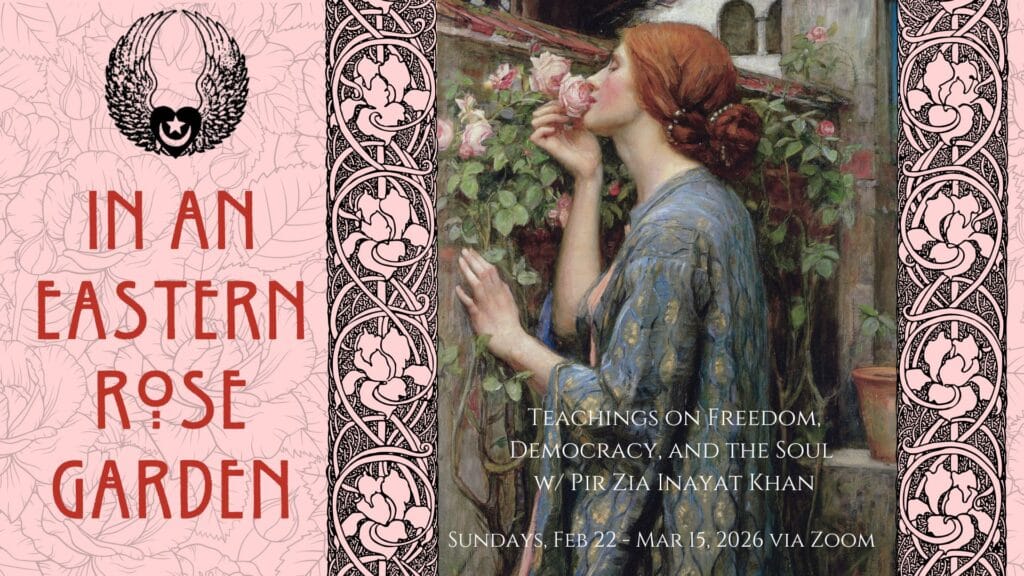
All beings pursue freedom. Freedom is an essential quality of the soul, but too often, freedom is achieved at the expense of someone else. A truer freedom arises from the realization of interconnectedness. This season we continue our exploration of the ideal of freedom.
Over four weeks, Pir Zia will guide us through topics such as the power of breath, spiritual democracy, freedom of the soul, and the ideal life. Each session will close with spiritual practices to carry into the week ahead. This program is open to everyone. More details and registration.

“If you could turn back the clock, would you fly back and change the past? Of course, we cannot change what we have said and done, or the actions of others—but we can change the way the past and present live in us. Knowingly or unknowingly, we are all creating a world within our heart, a world destined to outlast the seemingly objective world outside. The inner world becomes a Garden to the degree in which old enmities are transformed by means of fortifying insight, the circulation of life’s vital sap heals our most enduring wounds, guilt dissolves and coagulates as wisdom and acceptance, and the body-mind-soul nexus is made lucid and whole in the light of the All-Encompassing One.” — Pir Zia Inayat Khan
This program is in-person and via Zoom, with registration for both through Inayatiyya Deutschland. More details and registration.
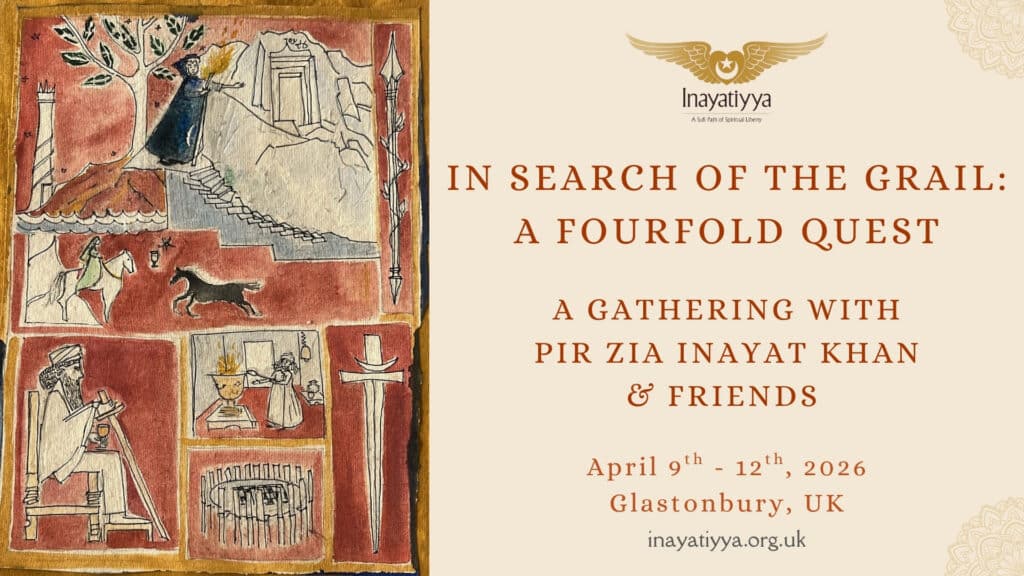
The Grail is the centrepiece of a series of legends spanning various lands and ages.Seen in its essence, the Grail reveals itself as the fulcrum of human existence, where inner and outer worlds converge, and life is perpetually renewed. Four numinous objects, or “Hallows,” function as fundamental aspects of its power to heal and transform: the Sword, the Spear, the Cup, and the Stone. By approaching these Hallows each in turn, the questing seeker is drawn ever closer to the mystery at the core of life.
We will gather for a short pilgrimage over four days in the heart of Glastonbury to peel back the layers of myth. Through storytelling, music, mediation and ritual, we will explore the mystery and wisdom of the Grail. More details and registration.
This month, we have news to share from the Caravan. Read more…
The Zephyr is a monthly newsletter of the Inayatiyya, an interfaith mystical fellowship with branches worldwide. For more information, please visit us at inayatiyya.org.